By Patrick Benham-Croswell
ANDY BURNHAM has fired the opening shots in the progressive establishment’s new war on the British people and Brexiteers (the majority in 2016). This is part of the process through which Burnham hopes to implement a progressive socialist ten-year plan, despite having less than three years until an election. Stalin couldn’t make five-year plans work, despite the best efforts of the Stakhanovites and the NKVD; Burnham’s ambition is commendably unbounded. To deliver his vision, he must retain power, which means he must win elections. That’s never easy, particularly in a “cost of living crisis”, largely caused by government policy.
If in doubt, lie
Typically (of both the prime minister and the establishment) the weapon of choice is dissembling. To the ruthless propagandist, and that is one thing Burnham is, a lack of helpful facts is no impediment – just make up some up. Thus we have glowing economic forecasts praising Burnham’s EU re-set deal (first set up by Starmer) and pictures of young Britons frolicking in the Euro-paradise.
Burnham also set up the classic straw man / false dichotomy, claiming the Brexit deal was “too hard”. It wasn’t hard; the hard/soft deal analysis is even more flawed than the left/right analysis of politics. The real choice was clean/messy. Clean meant a complete break with everything, and then negotiating back what we wanted. It would have worked, as professional and successful economist Liam Hallighan explained in his book Clean Brexit.
The UK didn’t get that; May’s muddling was replaced by Johnson’s “oven-ready” turkey of a deal, which was then further compromised by the Windsor agreement on Northern Ireland, signed by Sunak.
Burnham skipped over the adverse economic impact of covid but steadfastly asserted his line that Brexit had made the UK worse off and produced an opinion poll stating “Three quarters of people say that they favour closer ties with Europe”. That is a direct quote from the European Council on Foreign Relations’ latest research, designed to make the argument. It’s hardly unbiased; in polling of complex matters like Brexit, the question’s wording often determines the answers.
Bizarrely, Burnham’s speech stated that his reset “opens up the possibility of lower electricity costs and we look forward to exploring that opportunity with you as we go forward from today.”
It does no such thing and, as I have written countless times, the simplest way to reduce energy costs for the UK is to bin net zero (which is extortionate and impossible, as my book explains).
But neither Burnham nor the EU worry much about reality, detail or the opinions of the people; it’s all about power. So what was in the Starmer/Burnham/Blob great reset? Three, maybe four things, outlined below.
Agriculture
Border checks on UK food exports will be reduced, and so will the costs thereof, which can be as much as £1,400 per shipment. Even better, those who insist on taking their pets to Europe with them will pay less too. Hurrah.
In fact, the UK only exports about 10 per cent to 15 per cent of its agricultural produce. The largest destination country is Ireland. Livestock, grain and produce travel round the island of Ireland regardless of borders, as it has for centuries. 20 per cent goes to the US and to China and the rest, total value some £13 billion, goes to the EU. In the context of the UK’s £910 billion total annual exports, agriculture is a rounding error. “Every little helps..” and all that, but this reset won’t do much for the wider, ailing UK economy.
The reality is the UK is a net food importer; we import 42 per cent of what we eat, at a total cost of £68 billion. If we were prepared to eat more domestic produce and our appetite for offal was higher, we would export still less.
The price of all this? Dynamic alignment with the EU rules – which means taking them without being involved in decisions. These will impact on genetic research where the UK is a world leader. Estimates vary, but the genetic research alone is worth some £500 million per year, with future values in the intellectual property rights probably worth north of £3 billion a year. Adding EU legislation will not speed sector growth. Behind Burnham’s hype there is little economic benefit and significant risk of harm.
Movement
The reset allows 100,000 Britons to live, study and work in the EU for up to three years. In a novel definition, “young” now means under 32. The 70 per cent of the UK’s 1,000,000 NEETs, whom the Milburn Report says want to work, must be chuffed at the increased competition for today’s 690,000 job vacancies (ONS data). They’re already competing with the 6 million or so legal migrants; there is no labour shortage in the UK, no matter what Burnham thinks. More hype and more risk, not least because the UK is far from brilliant at tracking and removing those who overstay their visas.
Emissions
Emissions trading is a massively complex subject, essentially seeking to tax imported goods for the CO2 released by the energy required to manufacture them. The EU one is called ETS and the UK one is CBAM, which will launch on 1st January 2027. By merging them, UK exports to the EU will become exempt from levies, as will EU imports to the UK, from 2008. Last year the UK exported around €180 billion of manufactured goods to the EU, while importing €354 billion from there. (EU data).
Had we not merged our systems, we would be raising twice as much in emissions tariffs as we would be paying. Strangely, Burnham didn’t mention that.
There’s more to the deal, including international transport emissions. There are some problems. Firstly, Burnham accepted dynamic alignment (again). Secondly, the EU price for a ton of CO2 emissions is usually higher than the UK one, so when the schemes merge, energy-intensive industries like Ineos will take a hit. Thirdly the large scale frauds in the EU ETS system continue. By merging the UK system with the EU one we’re accepting dynamic alignment with a patently failing regulator.
Reset economics
Burnham quoted a brief procured for his Chancellor (who was also on the Brussels day trip) stating that the “UK Treasury has said that the deal struck here will add up to 0.5 per cent to UK GDP. That is a £17 billion boost to the British economy.” What the speech didn’t say was when that would come, although other briefings and releases said that’s by 2040.
If a week is a long time in politics, a decade and a half is eternity in economic forecasting. To produce a figure for the increase the modellers will have run their model twice. The base case of no reset deal, and then again with the parameters tweaked to incorporate the reset. All things being equal, the difference is due to the reset, because the other parameters are unchanged.
That’s in their models. In the past decade and a half the UK has endured the tail end of the financial crash, the Brexit war and its decision, Covid and the war in Ukraine, the Israel – Iran – USA confrontation, seven prime ministers and four general elections. In the real world, all things are never bloody equal and long range economic forecasts aren’t worth the electrons they consume. The Treasury’s pretence that it can calculate to the accuracy of a halfpenny in the pound fifteen years hence is risible.
It’s also deeply suspicious, as the Treasury is not objective; its (first) lord and master is the prime minister. Fortunately, there are other economists, including at the Growth Commission. The Growth Commission is staffed by professional economists, not wannabe politicians. Its chairman, Shanker Singham, has a rather different estimate, namely that Burnham’s EU reset trade benefits “are only 0.05 per cent of GDP to 2040.” It goes on to assess that the dynamic alignment for agriculture will cost £74 billion over the coming decade.
Universal idiots
Then of course there’s the university fee fiasco. Allegedly introduced at a late stage, the EU wants a reciprocal student fee reduction, and Bonehead Burnham has agreed, in writing, to discuss it. (I write allegedly as nothing happens spontaneously in the EU, or indeed any other Kafkaesque bureaucracy such as the Foreign Office). It was omitted from the Downing Street statement and Burnham’s speech, but it is in the Summit Agreement (buried at paragraph 41).
According to US News rankings (there are others, but the results are similar) of the top 50 universities in the world, just four are in the whole of the EU (Amsterdam at #39, Copenhagen #45, Leuven #48 and Munich #50). There are six British ones, consisting of Oxford at #4, Cambridge #5, UCL #9, Imperial at #14, Edinburgh at #41 and Kings College London #42. Of course the EU wants to send its students here on the cheap. It’s a huge bargaining stick, yet the Manchester motormouth has already agreed to do a deal. That will mean a substantial loss of income to the UK’s best universities. The reward? Access to inferior universities in Europe.
Only a dunderhead would agree to agree before seeing the terms of the deal. Anyone with a bit of nous would emulate President Trump and suggest if the EU wants cheaper tuition fees in the UK, it should come bearing gifts or there is no discussion to be had. The UK’s top universities have vendor power and such quality that they can dictate terms, as they currently do in the international student market, where they compete successfully with the likes of Harvard and MIT.
Whether the three deals that Burnham thinks are a fundamental to a UK/EU reset are contingent on a tuition fees deal is disputed. Brilliant. Either the clowns of Downing Street went to do a deal without reading the documents, or they had read them and chose to dissemble.
Democratic deficit
The speakers at the post-summit press conference alluded to the democratic values of the Western liberal rules-based international order.
The speakers were Ursula von der Leyen, the EU President selected by the European Council (an assembly of the heads of state of the EU nations) and ratified by the European Parliament; her democratic legitimacy lags that of President Trump (and every other US president), who won a straight majority in a direct vote. So did President Putin, for that matter.
The other EU speaker was the President of the European Council, António Costa, a former Portuguese prime minister. The EC president is voted for by the EC Member states, again, no direct election from the EU electorate.
And then of course, there’s the former King of t’North. He won a by-election in Makerfield to give him a chance of replacing Kier Starmer through a Downing Street putsch. He didn’t even face election by Labour MPs. Quite how he organised the coup is beyond my ken, but coup it was. Now he and apparatchiks of the EU have the temerity to lecture us on democracy and rules. That’s like getting a lesson on ethics from Peter Mandelson.
Backlash
Burnham is a professional politician to the exclusion of all else. His mission is to win the next general election (which only he can call) and the one after that. Given the cost of living problems, spiralling deficit, soaring interest costs and leaping energy costs that’s a tough ask. However, winning an election only requires getting more votes than the other parties in a majority of constituencies, which is arguably easier than solving the country’s problems.
The longer he delays it, the worse the economy will be, although he and his acolytes may not understand that. Burnham’s attempted Brexit betrayal won’t work as hoped. It will give strength to the argument that the state is broken and that professional politicians (like Burnham) are part of the problem. No number of appearances on Celebrity Gogglebox (or, more appropriately perhaps, Celebrity Traitors) will overcome that.
Burnham may not realise it, but he faces a winter of discontent. That ended badly for Richard III and Jim Callaghan. If, or when, the cost of living reaches crisis point we’ll see what Burnham is made of.
This an edited version of an article first published on 21 November on Paddy’s substack – ‘Views From My Cab’ a reader-supported publication. Subscription costs you nothing but makes the SubStack bots more helpful. Subscribing will also deliver new articles to your inbox.
Established in 1997 and celebrating 29 years of championing British sovereignty, Global Britain is a not for profit relying on donations to publish our papers, briefs and articles. You can subscribe to receive our publications here – share and follow us on ‘X’ here – and facebook here – and make a donation here. Every contribution helps to meet our overheads.
Patrick Benham-Crosswell spent a decade as an Army Officer before becoming a successful entrepreneur. He has written books on soldiering and net zero as well as appearing on GB News and elsewhere as a defence commentator.
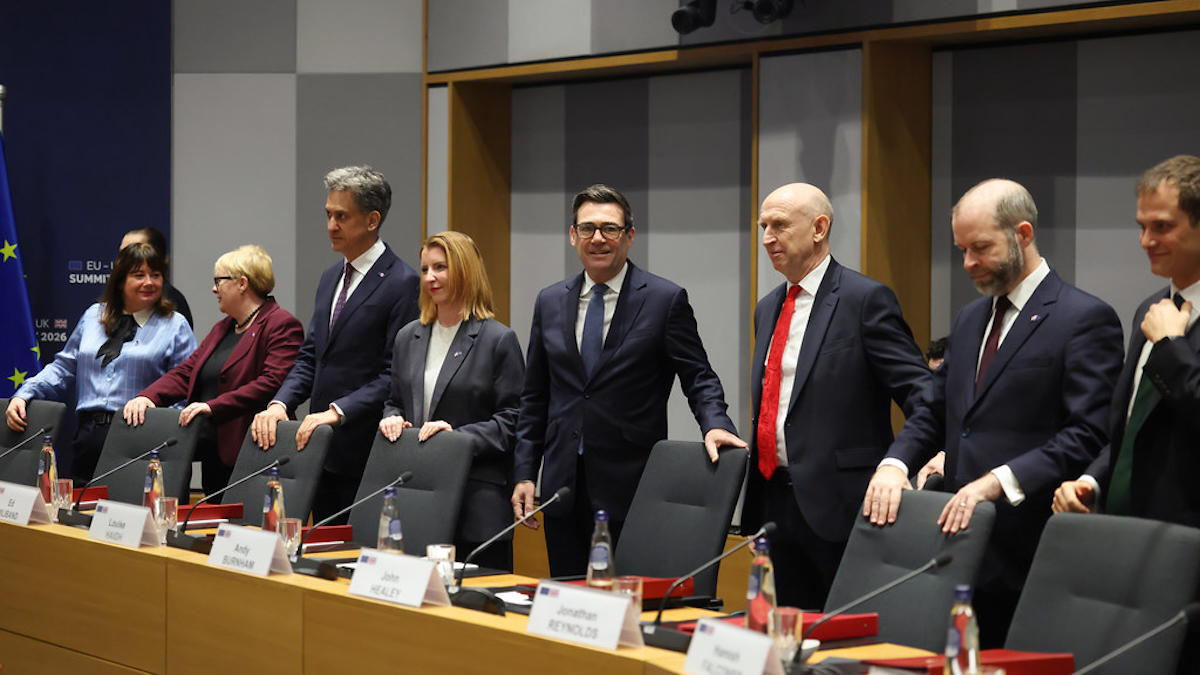
Prime Minister Andy Burnham attending EU-UK Summit by UK Government, CC BY-NC-ND 4.0