By Catherine McBride OBE
TWO CHEERS for Jonathan Reynolds, who has announced that he will not follow the EU and impose additional tariffs on imported Chinese electric vehicles (EVs). This is the correct decision.
Free trade is great, but it must actually be ‘free trade’ for everyone. That means we should not only be able to import the cars British people want to buy freely, but also allow UK car manufacturers to make the cars their customers want to buy. That would get the full three cheers!
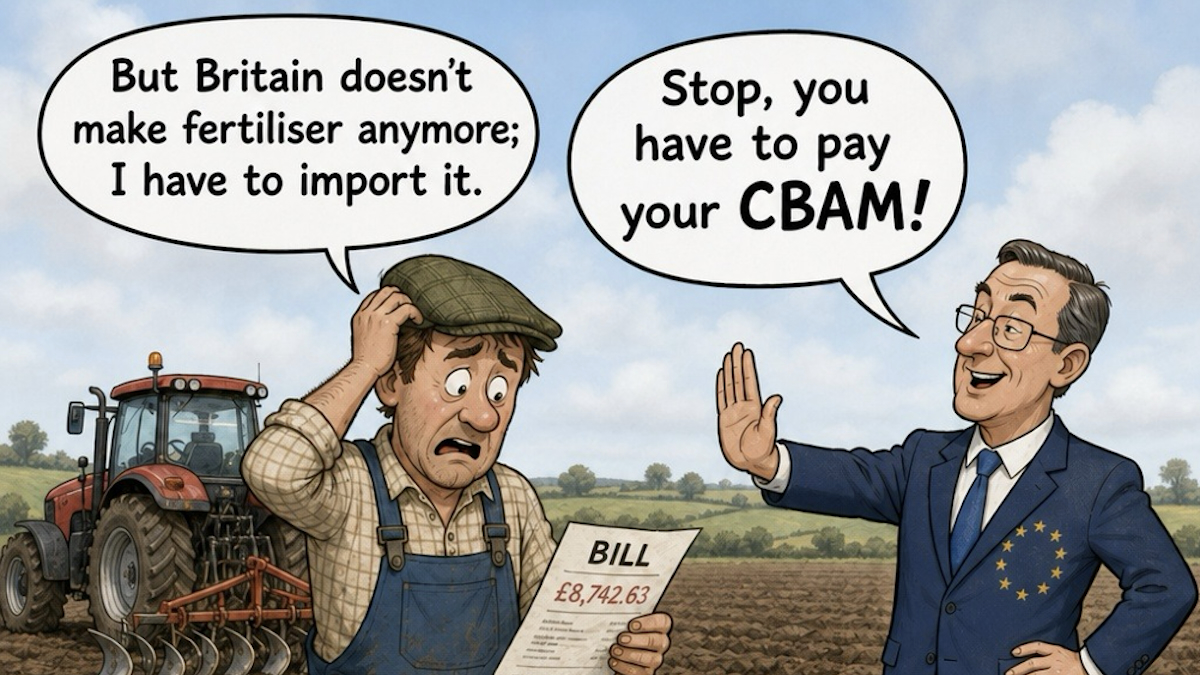
The biggest problem for UK car manufacturers is not competition from China, but the UK’s EV mandate, the UK’s fines for car manufacturers for selling ‘too many’ petrol and diesel vehicles, the UK’s emissions trading scheme and other carbon taxes, the UK’s world-beating ‘industrial electricity prices', and, soon, the UK’s Carbon Border Adjustment Mechanism (CBAM) that will add a carbon tariff onto the steel and aluminium UK manufacturers need to import to make their cars.
It is these additional and unnecessary costs that are killing the UK car industry, not imports. If the government plans to let Chinese cars compete relatively freely in the UK market (they will still face 10 per cent tariffs), then it should also let UK car manufacturers compete freely and produce the cars they make most efficiently.
Reynolds, who was attending a trade summit in India, also admitted that the newly agreed UK-India trade deal would be defunct if Britain rejoined the EU. This trade deal has already increased UK exports to India and should not be abandoned to appease a failing EU.
This week, the IMF published its economic growth predictions for 2026 and 2027, and India is predicted to grow by 7 per cent in both years; China is expected to grow by 4.5 per cent this year and 4 per cent next year; while the US is expected to grow by 2.3 per cent both this year and next. Why would we abandon trade with these markets when the Eurozone’s growth is predicted to be just 1.1 per cent this year and 1.2 per cent next year?
In both years, Eurozone growth is slightly lower than the UK’s predicted growth of 1.3 per cent and 1.2 per cent. It's a mystery why anyone would think the UK would be better off getting closer to the EU rather than embracing the rest of the world.
Europe has a strange relationship with China. German companies got rich exporting goods to China, but now that China can make the same goods for less, the EU has no interest in letting trade flow the other way. As ever with the EU, it is one rule for them and a completely different rule for everyone else.
But that doesn’t mean everything is rosy in the UK car industry. It isn’t. But restricting trade with China won’t fix it. However removing the EV mandates, the high cost of energy, and the carbon taxes might.
The UK has mandated that all new car sales be zero-emission vehicles (ZEVs) by 2035, and that 80 per cent of cars and 70 per cent of vans be ZEVs by 2030. In 2026, if fewer than 33 per cent of new car sales are ZEVs, the company is fined £15,000 for each additional Internal Combustion Engine (ICE) car sold; and 24 per cent of new van sales must be EVs; if not, the company is fined £18,000 for each additional ICE van sold.
Despite this EV mandate, the UK depends heavily on China for the raw materials needed to make EV batteries and for finished battery packs. The UK has not imposed a tariff on the imported EV batteries because it needs them to manufacture EVs in the UK. So why do we have this mandate at all?
The EU is also happy to import EV batteries tariff-free, but it wants to keep the rest of EV manufacturing in the EU, with heavy tariffs of up to 45.3 per cent (the baseline 10 per cent plus anti-subsidy 35.3 per cent tariff) on subsidised Chinese EVs; with reduced rates of 20.7 per cent for ‘cooperating manufacturers’, such as BMW, VW, and Volvo, which manufacture their EVs in China. The annual EU import quota is 350,000 vehicles.
Letting the EU set the UK’s trade regulations, including its tariff and quota schedule, was never in the best interests of UK businesses. Why would we even consider this now?
Catherine McBride OBE is an economist who writes regularly about trade, agriculture and markets for Briefings for Britain, Global Britain, and The Critic. She is CEO of the Great British Business Council and a member of the Tax Reform Council's Advisory Board. Catherine also appears on TV, radio, and podcasts.
Established in 1997 and celebrating 31 years of championing British sovereignty, Global Britain is a not for profit relying on donations to publish our papers, briefs and articles. You can subscribe to receive our publications here – share and follow us on ‘X’ here – and facebook here – and make a donation here to keep us going. Every contribution helps to meet our overheads.
Photo of Chinese EVs by Hamza via Adobe Stock