At the United Nations, Trump noticed the noun rather than the adjective and laid out a foreign policy built on recovering the levers of the sovereign state
By Bepi Pezzulli
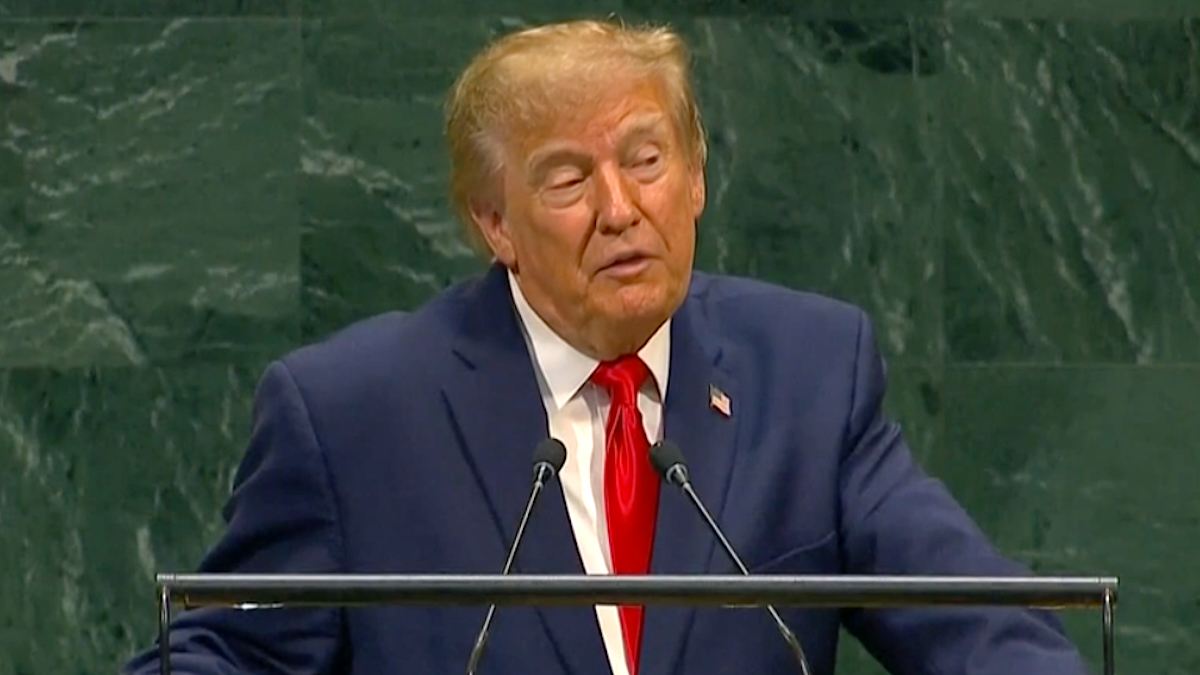
DONALD TRUMP went to the United Nations to explain that the United Nations is not the government of the world. Judging from some of the reaction, this came as news.
The most revealing sentence in Trump’s address to the 81st General Assembly was also the shortest: “There is no global government.” Elsewhere, he spoke of borders, migration, the International Criminal Court, artificial intelligence, Iran, the Western Hemisphere and American military power. Read as another instalment of Trumpian provocation, these subjects appear loosely connected. Read politically, they form something considerably more coherent: a theory of sovereignty.
Trump understands something his critics frequently obscure by concentrating on his manners. Sovereignty is not a sentiment. Nor is it a synonym for nationalism. It is the possession of the final power to decide: who enters the territory, which law governs it, who may exercise coercion, what international obligations bind the state, which technologies it controls, and against which threats it is prepared to use force.
In that sense, Trump’s second presidency can increasingly be understood as an attempt to recover, one after another, the levers through which sovereignty is exercised.
The border is the most obvious. A state unable to determine the conditions under which foreigners enter and remain within its territory retains juridical sovereignty while surrendering part of its operational content. Trump therefore treats immigration enforcement as a constitutional question in the older meaning of the word: who governs? His formulation at the UN was characteristically unadorned: “There is no human right to illegal immigration, but there is a right to remain a sovereign nation.”
Then comes jurisdiction. Trump’s assault on the International Criminal Court was rhetorically extravagant, but the underlying dispute is perfectly intelligible. The United States is not a party to the Rome Statute. Trump rejects the proposition that an institution whose jurisdiction the United States has not accepted should exercise authority over American personnel, and at the UN he called upon ICC member states to leave the Court. One may agree or disagree with that position; it is nonetheless a dispute about where ultimate legal authority resides, rather than an inexplicable tantrum against international law.
Technology supplies another lever. António Guterres used his address to call for stronger international governance of artificial intelligence. Trump answered from almost the opposite philosophical position, rejecting what he called a “globalist scheme of control” over AI. Here again the question beneath the rhetoric is sovereignty: whether the rules governing the technology likely to underpin future economic and military power will ultimately be made by states, international bodies, or some combination of the two.
Then there is the oldest sovereign prerogative of all: force. Trump’s treatment of Iran is especially instructive because it exposes the weakness of interpreting his foreign policy simply as either isolationist or interventionist. Neither category quite works. He threatened overwhelming force while negotiations with Tehran were continuing; after the speech, he said those talks were making progress and that he expected a settlement. The method is transactional, coercive and unmistakably state-centric: diplomacy is valuable because it can produce an agreement, while military power supplies the bargaining position from which diplomacy proceeds.
The same logic appeared in his discussion of the Western Hemisphere. Trump declared that Washington would no longer permit threats to the United States to establish themselves there and said American military power would be used when necessary to defend vital national interests. His administration has coupled that doctrine with military action against narcotics trafficking and the capture of Nicolás Maduro in Venezuela. Whatever judgment one reaches about the legality or prudence of individual actions, the conceptual architecture is recognisable: spheres of strategic interest, territorial security, deterrence and the restoration of state capacity.
This is where Trump Derangement Syndrome becomes analytically expensive. If every Trump statement must first be processed as an outrage, very little intellectual bandwidth remains for asking what the administration is actually doing. Trump’s language makes the temptation particularly strong. He speaks in superlatives where a foreign-policy seminar would prefer subordinate clauses. Yet vocabulary should not be confused with doctrine. Behind the boasts sits a conception of international politics much older than the post-Cold War order: sovereign states remain the principal political actors; international institutions derive their usefulness from the states that sustain them; military capability underwrites diplomacy; borders define political communities; and treaties are instruments of statecraft rather than substitutes for it.
This does not amount to withdrawing from the international system. Quite the contrary. Trump delivered the argument at the United Nations, negotiated with Iran while threatening it, worked with regional governments against cartels and spent the same UN gathering conducting bilateral and multilateral diplomacy. The operative distinction is between international cooperation and supranational authority. His administration appears comfortable with the former precisely because it rejects the latter.
There is also a specifically American dimension. The sovereignty Trump describes is not merely defensive. He couples control over borders and jurisdiction with military supremacy, technological leadership and regional predominance. Sovereignty, in this conception, requires capacity. A country may possess a flag, a seat at the UN and an internationally recognised frontier; if it cannot police that frontier, protect its citizens, determine the reach of its laws or defend its strategic interests, its sovereignty is increasingly ceremonial.
That helps explain the refrain running through the speech: “while others have talked, I have acted.” It is campaign rhetoric, certainly. It is also a claim about political agency. Trump measures government less by the sophistication of the rules it promulgates than by whether the state can cause something to happen. Iran must not acquire a nuclear weapon. Cartels must not enjoy sanctuary. American soldiers must not answer to a court Washington never joined. Immigration rules must determine who enters the country. American AI must not acquire an international regulator merely because international regulation sounds reassuring.
There is, if anything, an opposite criticism to be made. Trump’s rhetoric sometimes runs ahead of his willingness to act. Having described the stakes in existential terms, his administration can hesitate at precisely the moment when language demands consequence. The problem is not that Trump’s doctrine is too radical, but that its execution is occasionally insufficiently so. A theory of sovereignty ultimately depends upon credibility: once power has spoken in the language of decision, hesitation carries a price. The remedy is therefore greater correspondence between word and deed, not more modest words.
For several decades, Western political discourse often behaved as though sovereignty were an embarrassing inheritance from an uncivilised past, something advanced societies might gradually subcontract to courts, conventions, bureaucracies and transnational governance. Trump treats it instead as political capital: accumulated painfully, surrendered easily and recovered only through the exercise of power.
His UN speech was therefore less a rebellion against the international order than a reminder of what the international order is made of. The organisation’s name rather gives the game away. It is the United Nations, after all.
Trump appears to have cast the light back on the noun rather than the adjective.
Bepi Pezzulli is the Political Director of Italia Atlantica. He is a Solicitor in England & Wales and an Avvocato in Italy. A foreign-policy scholar, he is a councillor of the Great British PAC and Britain Unbound. He posts at @bepipezzulli.
Established in 1997 and celebrating 31 years of championing British sovereignty, Global Britain is a not for profit relying on donations to publish our papers, briefs and articles. You can subscribe to receive our publications here – share and follow us on ‘X’ here – and facebook here – and make a donation here to keep us going. Every contribution helps to meet our overheads.
Photo courtesy of UNTV.