By Bepi Pezzulli
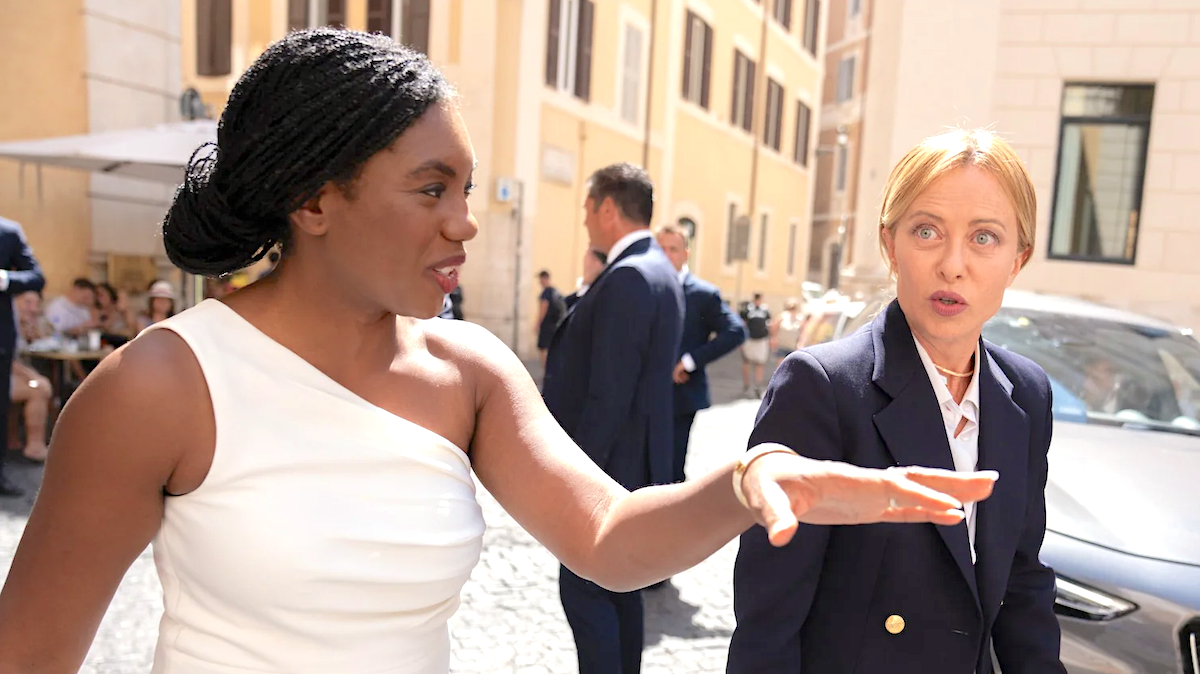
GIORGIA MELONI is about to achieve something that once seemed almost impossible in Italian politics: longevity. On 4 September, she will become the longest continuously serving prime minister in the history of the Italian Republic. That achievement alone explains why Kemi Badenoch spent an hour with her in Rome this week. Italy, she observed after their meeting, once looked like Europe's economic problem child. Today its borrowing costs are below Britain's. Meloni, Badenoch wrote, has “restored confidence in Italy, brought job creators back. Most revealingly: “I wanted to understand how she did it.”
Britain should indeed study Meloni. But it should study the whole record rather than the legend.
From protest to power
The first lesson is political rather than ideological. Meloni understood that a protest party becomes credible by behaving as though it intends to govern. Brothers of Italy entered government in 2022 carrying considerable political baggage. Its roots run through the post-fascist Italian right; Meloni had spent years attacking Brussels, illegal migration and Italy's political establishment. Her opponents expected either radicalism or rapid collapse. She supplied neither. Instead, she established control over her coalition, reassured markets, maintained Italy's commitments to NATO and Ukraine and developed a working relationship with hostile European institutions. She did this without repudiating the political identity that had brought her to office.
Meloni's success came from making Brothers of Italy the dominant institution on the Italian right. She did not achieve that by dissolving herself into competitors. She gave voters a reason to move towards her. For Conservatives competing with Reform, there is wisdom there. Trying to reproduce every Nigel Farage position would validate the proposition that Reform is the original and the Conservatives an imitation. Meloni's example suggests another strategy: decide what conservatism means, defend it consistently and demonstrate that it can govern.
Credibility before revolution
There is an economic lesson too, although any observer should be careful not to overstate it. Italy has undoubtedly acquired greater fiscal credibility. The deficit fell to 3.1 per cent of GDP in 2025, while the primary surplus rose to 0.8 per cent. The IMF records a substantial compression in sovereign spreads and a 70-basis-point fall in Italy's average yield at issuance during 2025. The labour market has also performed strikingly well by Italian standards. Employment stood at 24.31 million in June, with an employment rate of 62.9 per cent and unemployment of 5.7 per cent. When Meloni entered office in late 2022, the employment rate was around 60.5 per cent and unemployment 7.8 per cent. There is therefore substance behind Badenoch's admiration for the restoration of confidence. But Italy has not experienced an economic miracle. The European Commission expects real GDP growth of only 0.5 per cent in 2026 and 0.6 per cent in2027. Public debt, already 137.1 per cent of GDP in 2025, is projected to reach 139.2 per cent in 2027. The IMF likewise warns that Italy remains vulnerable to weak growth and interest-rate shocks. The OECDidentifies the deeper problem: productivity, taxation and structural barriers remain formidable. Italy's tax wedge on an average single worker is 47.1 per cent, among the highest in the OECD.
Britain should therefore distinguish Meloni's achievement in restoring credibility from success in transforming the Italian economy. The former is real. The latter remains unfinished. There is a key takeaway there because British Conservatives have sometimes confused radical rhetoric with radical government. Markets are rather less interested in rhetoric. Meloni discovered that fiscal restraint can itself be a conservative political instrument. A government seeking sovereignty must first convince its creditors that it understands the reality of markets.
Changing the politics of migration
Migration provides a second, more complicated lesson. Measured purely by the ambition of the rhetoric with which Meloni came to office, her record is disappointing. Italy has not sealed its borders. Its economy continues to require foreign labour, and the government has accommodated substantial legal migration. The Italian state also remains constrained by domestic courts, European law, administrative weakness and the interests of employers. Yet focusing exclusively on migrant numbers misses what Meloni has accomplished politically. Her Albania centres attempted to establish the principle that migration processing and returns need not take place inside EU territory. Courts repeatedly obstructed implementation. Meloni persisted. In April, Advocate General Nicholas Emiliou concluded that the Italy-Albania protocol could be compatible with European law. The opinion is not binding, and the legal battle is not over. But an idea initially dismissed as legally impossible has moved towards the European mainstream. Other governments are examining versions of the model. Italy went further during this summer's Ceuta crisis, temporarily reintroducing controls on arrivals from Spain and coordinating strengthened controls with France. Meloni and Denmark's Mette Frederiksen have simultaneously pushed the European debate towards external processing and a harder approach to irregular migration.
This may be Meloni's most consequential achievement. Governments change policy partly by changing what other governments consider politically possible. For Britain, outside the EU but still constrained by the European Convention on Human Rights and its own courts, the lesson is particularly relevant. Institutional constraints cannot simply be wished away. A government either acquires the political capital to change them or learns to operate around them.
There is, however, a warning here too. Political signalling cannot indefinitely substitute for execution. The Albania project consumed enormous political energy while spending long periods effectively immobilised by litigation. Britain has already experienced its own version of the problem with Rwanda. Announcing an ingenious scheme is not the same thing as constructing an administrative system capable of removing people. Meloni's record consequently suggests political commitments to leave the ECHR should be judged not by announcements, but by what follows it: legislation, administrative capacity, bilateral agreements, detention infrastructure, returns arrangements and a civil service capable of implementing ministerial decisions. Without those things, sovereignty becomes theatre.
Where power really resides
There is another Italian lesson which British conservatives should study carefully: the state itself. Italian governments traditionally operate within an unusually dense network of institutional constraints. The presidency of the Republic, Constitutional Court, judiciary, bureaucracy, Court of Auditors, European institutions, coalition partners, organised economic interests and, crucially, the Vatican all possess varying degrees of political influence. Foreign policy adds Washington and NATO to the equation. Meloni has often been forced to manoeuvre rather than command. That helps explain both her success and her limitations. She has survived because she understands the difference between winning an election and possessing the institutional power necessary to implement an electoral mandate. Britain's constitutional structure is different, but the problem is increasingly familiar. Ministers discover that policy passes through regulators, courts, arm's-length bodies, international obligations and a permanent administrative apparatus whose institutional preferences do not necessarily change when governments do.
The useful lesson from Rome is therefore not that conservatives should declare war on the British deep state. It is that a government serious about political change must understand where power actually resides before entering office. Personnel, legislation, institutional design and administrative preparation matter as much as manifestos.
Meloni's foreign policy offers perhaps the clearest warning. For much of Donald Trump's second presidency she enjoyed an unusually privileged position in Washington. Her ideological affinity with the American MAGA right appeared to give Italy influence disproportionate to its economic weight. Then national interests diverged. Meloni refused to support the American war against Iran. Her relationship with Trump deteriorated sharply. What had looked like a strategic political friendship proved vulnerable once Rome and Washington wanted different things.
There is an obvious lesson for a Global Britain. Personal relationships matter in diplomacy, especially with political leaders who conduct foreign affairs personally. But they are not alliances. Britain should cultivate Washington intensely while retaining the capacity to say no when British interests require it. Atlanticism is strongest when it rests on convergent interests rather than personal dependency. Meloni's earlier success in maintaining support for Ukraine despite opposition on both her left and right illustrates the better principle. As she explained to Badenoch, support for Kyiv was ultimately about Italy's security, not Ukrainian gratitude or ideological fashion.
That conception of national interest is something British conservatism could profitably recover.
Allies, interests and independence
There is finally a lesson in expectations. Meloni has changed Italy less than her supporters hoped and considerably more than her opponents expected. Italy remains burdened by enormous debt, anaemic productivity, demographic decline, administrative dysfunction and an immigration system that bears little resemblance to the rhetoric of 2022. None of these problems disappeared because a conservative entered Palazzo Chigi. What changed first was political direction. Meloni made positions previously regarded as beyond the European consensus respectable subjects of governmental negotiation. She demonstrated that a party originating outside the traditional governing establishment could become the stable centre of a governing coalition. She combined confrontation with Brussels on some questions with cooperation on others. And she understood that conservative politics cannot survive on protest once it acquires responsibility for the state.
This is why British politicians and commentators are right to study Meloni, provided the failures are studied as closely as the successes. The British lesson from Meloni is not to copy Italian policies. It is to understand the sequencing of political change. Establish a coherent identity. Win control of your own political family. Acquire economic credibility. Understand the institutions capable of frustrating implementation. Push those institutions where necessary, negotiate where useful and never mistake announcements for outcomes. Maintain alliances without outsourcing the national interest. Above all, Meloni's experience suggests that a conservative government should be judged by whether the political settlement after it leaves office is different from the one it inherited.
Italy has not undergone the conservative transformation some expected in 2022. But four years later, arguments once confined to the Italian right are being conducted in chancelleries across Europe. That is political power of a different kind. For those keen to learn from Italy’s experience under Meloni, that may be the most valuable lesson Rome has to offer.
Bepi Pezzulli is the Political Director of Italia Atlantica. He is a Solicitor in England & Wales and an Avvocato in Italy. A foreign-policy scholar, he is a councillor of the Great British PAC and Britain Unbound. He posts at @bepipezzulli.
Established in 1997 and celebrating 31 years of championing British sovereignty, Global Britain is a not for profit relying on donations to publish our papers, briefs and articles. You can subscribe to receive our publications here – share and follow us on ‘X’ here – and facebook here – and make a donation here to keep us going. Every contribution helps to meet our overheads.
Photos courtesy of Number 10 - https://www.flickr.com/photos/number10gov/55213350060/in/dateposted/, OGL 3, https://commons.wikimedia.org/w/index.php?curid=189528051 and CCHQ.